Beyond AI Literacy: A Future-Ready and Protective Framework for Schools
What I’m bringing to Colorado’s school board: model text for AI competencies and SEL integration

Recently, I published a sample AI policy for schools. It struck a chord far beyond what I expected. The text has been translated into German for discussion with Austrian schools. It’s on the agenda for conversations with UK university administrators later this month. I also learned how Ohio has taken a leading position mandating the development of AI policies for every K-12 school. Meanwhile, here in Boulder, my local board has said they can’t even begin discussing it until January at the earliest.
That gap between the urgency of what’s happening in classrooms today and the slow pace of formal conversations is why I keep writing these posts. We don’t need more broad statements about the importance of AI literacy. We need model language. Words that school boards, superintendents, principals, and teachers can steal, amend, and improve. Language that doesn’t dictate local choices but provides a solid starting point so well-meaning leaders can move at the pace this moment requires.
In Colorado, AI appears in the state’s academic standards but is siloed under Computer Science. Preparing our kids for a future where AI is everywhere goes far beyond technical skills.
The skills required for future-ready students cross nearly every discipline and include ability to navigate the emotional and social challenges AI introduces.
The demands are continuous, evolving, and without a finish line.
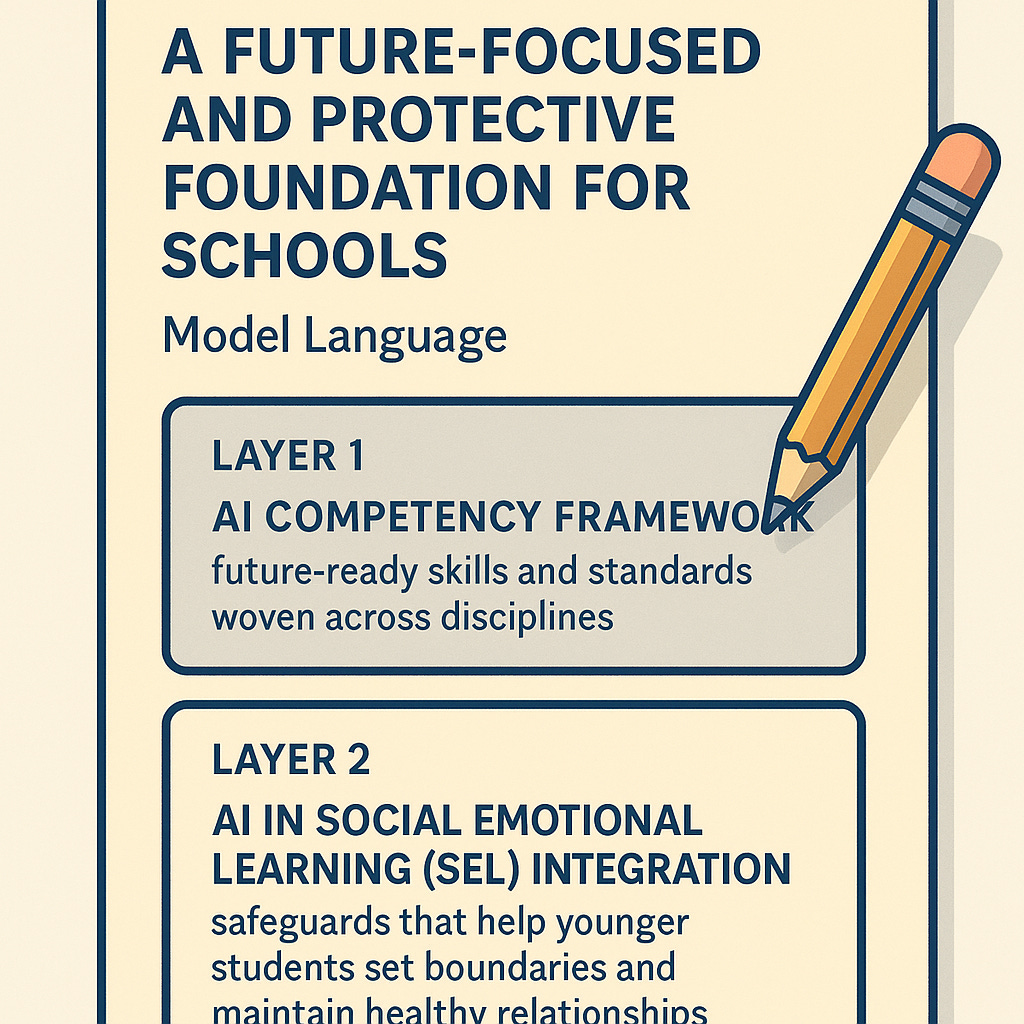
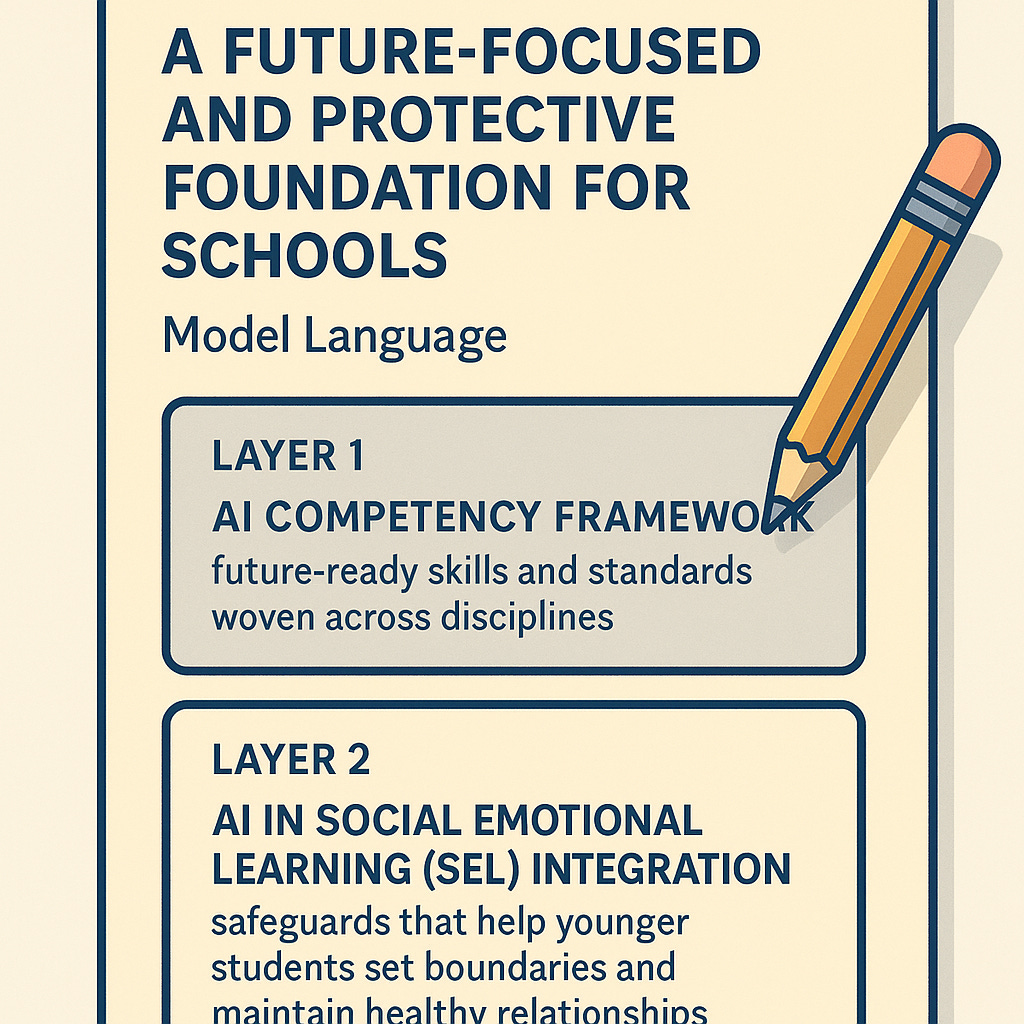
In that spirit, today I’m sharing model text that goes beyond “AI literacy” and proposes a two-layer framework that is both future-ready AND protective:
AI Competency Framework — future-ready skills and standards woven across disciplines, culminating in a graduation option.
AI in Social Emotional Learning (SEL) Integration — safeguards that help younger students set boundaries and maintain healthy relationships in a world where AI is already acting like a companion.
I plan to bring this framework to my state’s Board of Education and continue speaking at local board meetings to draw attention to the urgency of these discussions.
Below you’ll find draft language in full (use these links to jump to sections):
Preparing Students for an AI Future: Summary of the Two-Layer Approach
Draft: Colorado Academic Standards for Artificial Intelligence Competencies
Draft: AI Integration into Colorado Social Emotional Learning Competencies
Disclosure: I’m not an expert in state education standards. I partnered with ChatGPT-5 to turn concepts into draft model language designed as a starting point.
As with my earlier policy draft, I’m releasing this under a broad Creative Commons license. Use it. Adapt it. Share it. All I ask is that if you draw from this work, you cite it and point back so I can learn how it’s being applied.
Preparing Students for an AI Future
A Two-Layer Approach
Layer 1 — AI Competency Framework
Future-ready foundation
Define clear, cross-disciplinary competencies so every Colorado student graduates with the ability to use, question, and adapt to AI responsibly.
Layer 2 — AI in SEL Integration
Protective foundation for developing minds
Embed AI directly into Social-Emotional Learning (SEL) competencies, helping younger students navigate boundaries, relationships, and trust in a world with AI companions and tutors.
Why Both?
· Competency alone is not enough. Students can understand AI but still form unhealthy attachments.
· SEL alone is not enough. Students may avoid risks but miss future-ready skills.
· Together, they prepare students to thrive and protect them.
Sample Competency Statements (Layer 1)
· Elementary: “Students can identify when a digital tool is AI-powered, explain in simple terms how it works, and check its answers against trusted human sources.”
· Middle School: “Students can evaluate AI outputs for bias, trace sources of information, and explain when human judgment must override automated suggestions.”
· High School: “Students can responsibly integrate AI into creative, analytical, and collaborative projects; distinguish clearly between original and AI-assisted work; and practice transparent disclosure.”
· Graduation Option: AI Futures Portfolio — a multi-part demonstration including:
o A bias and ethics analysis of an AI system,
o A reflection on disclosure, limits, and responsible use,
o A creative project co-developed with AI showing human-AI collaboration,
o A forward-looking proposal for how AI could be applied responsibly in a civic, academic, or workplace context.
Sample SEL Extensions (Layer 2)
· Self-Awareness: “Recognize feelings when interacting with AI and distinguish between human and simulated empathy.”
· Self-Management: “Set personal limits on AI use for companionship or stress relief.”
· Relationship Skills: “Explain why human friendships differ from AI interactions and practice balancing both.”
· Responsible Decision-Making: “Decide when and how to disclose AI’s role in communication or schoolwork.”
What the State Board Can Do
· Standards & Graduation: Add cross-disciplinary AI competencies to the Colorado Academic Standards (CAS) and create an optional AI Futures Portfolio in the Graduation Guidelines.
· SEL: Integrate AI examples into existing SEL competencies as contextual indicators.
· Respect Local Control: Districts keep full authority over curriculum and implementation.
The Ask
“Colorado should lead with a both-and approach: an AI Competency Framework that builds future-ready graduates, and AI-infused SEL competencies that protect younger students. Together, these give families, teachers, and students clear answers to what healthy, responsible AI use looks like in our schools.”
Draft: Colorado Academic Standards — Artificial Intelligence Competencies
Content Area: Technology and Media Literacy (with cross-references to Computer Science, Reading/Writing/Communicating, and Social Studies)
Prepared Graduate Competency: Students will understand, evaluate, and responsibly apply artificial intelligence across academic, civic, and workplace contexts—integrating skills from literacy, communication, civic reasoning, and technical fields.
Standard 1: Understanding & Awareness
Prepared Graduate Statement: Students demonstrate awareness of AI systems, their uses, and their limitations.
Grade Level Expectations:
3rd Grade (AI.3.1): Identify when a digital tool uses AI and explain, in age-appropriate language, how it “learns” from patterns.
5th Grade (AI.5.1): Compare AI-generated answers with trusted human sources and describe when one should be preferred.
8th Grade (AI.8.1): Explain limitations of AI (e.g., hallucinations, missing context, or bias in data).
High School (AI.HS.1): Analyze how AI impacts fields such as healthcare, media, and civic participation, identifying both opportunities and risks.
Standard 2: Critical Evaluation & Ethics
Prepared Graduate Statement: Students evaluate AI outputs, recognize bias, and make responsible, ethical decisions about use.
Grade Level Expectations:
3rd Grade (AI.3.2): Recognize that computers sometimes give wrong or unfair answers.
5th Grade (AI.5.2): Identify when an AI response shows bias or unfairness.
8th Grade (AI.8.2): Propose strategies to check or balance bias in AI outputs.
High School (AI.HS.2): Critically evaluate ethical implications of AI in society, including fairness, accountability, and transparency.
Standard 3: Responsible Use & Disclosure
Prepared Graduate Statement: Students use AI responsibly and transparently, with clear boundaries between human and AI work.
Grade Level Expectations:
3rd Grade (AI.3.3): Explain when it is okay to use technology help and when to ask a person.
5th Grade (AI.5.3): Demonstrate responsible use of AI tools by citing or acknowledging help received.
8th Grade (AI.8.3): Distinguish between original work and AI-assisted work in projects.
High School (AI.HS.3): Model transparent disclosure of AI use in academic, civic, or creative work.
Standard 4: Creative & Collaborative Application
Prepared Graduate Statement: Students collaborate with AI to produce innovative work, showing originality and human oversight.
Grade Level Expectations:
3rd Grade (AI.3.4): Use simple AI-powered tools (like text-to-speech or drawing apps) with guidance.
5th Grade (AI.5.4): Create a short project that combines student ideas with AI-generated content.
8th Grade (AI.8.4): Collaborate with AI to solve a problem, documenting both AI and human contributions.
High School (AI.HS.4): Design a project where AI is used as a partner for inquiry, innovation, or creativity, while ensuring originality and ethical use.
Graduation Guidelines: AI Futures Portfolio
Demonstration: To satisfy competency for graduation, students may submit a portfolio that includes evidence drawn from multiple disciplines:
Bias & Ethics Analysis (Social Studies / Civics): A written or multimedia critique of how an AI system influences fairness, accountability, or civic life.
Research or Communication Project (ELA): A project where AI-assisted writing or analysis is transparently disclosed, with reflection on originality and integrity.
Creative or Technical Project (Computer Science / Arts / STEM): A co-developed work showing effective human–AI collaboration, with clear human oversight.
Forward-Looking Proposal (Career & Postsecondary Readiness): A presentation on how AI could be responsibly applied in a future workplace, academic, or community context.
Draft: AI Integration into Colorado SEL Competencies
Context: SEL domains and competencies are already adopted in Colorado. The proposal is to enrich them with AI-infused indicators that help students navigate relationships and decisions in a world where AI systems are social actors.
Domain 1: Self-Awareness
Original intent: Recognize emotions, thoughts, and values.
AI-infused indicators:
Elementary: Identify how I feel when interacting with an AI (e.g., comfort, confusion, frustration).
Middle School: Recognize that AI may simulate empathy but does not experience emotions.
High School: Reflect on how reliance on AI for affirmation or advice influences my self-image and decision-making.
Domain 2: Self-Management
Original intent: Regulate emotions, thoughts, and behaviors.
AI-infused indicators:
Elementary: Practice setting limits on time spent using AI chatbots or digital companions.
Middle School: Develop strategies to balance AI-assisted work with personal effort.
High School: Establish personal guidelines for when to seek human connection instead of relying on AI for emotional support.
Domain 3: Social Awareness
Original intent: Show empathy, respect, and understanding of others.
AI-infused indicators:
Elementary: Understand that AI cannot truly “understand” my feelings, even if it sounds like it does.
Middle School: Compare interactions with peers to interactions with AI, identifying what only people can provide (e.g., authentic empathy).
High School: Critically analyze how AI influences social dynamics, from online conversations to recommendation systems.
Domain 4: Relationship Skills
Original intent: Build healthy relationships, communicate clearly, resolve conflict.
AI-infused indicators:
Elementary: Explain why friendships are different from using AI for fun or advice.
Middle School: Demonstrate healthy boundaries between AI companions and peer relationships.
High School: Practice disclosure when using AI in communication (e.g., stating when an AI helped draft a message).
Domain 5: Responsible Decision-Making
Original intent: Make ethical, constructive choices.
AI-infused indicators:
Elementary: Decide when it’s best to ask a trusted adult instead of an AI system.
Middle School: Identify risks of sharing personal information with AI and choose safer alternatives.
High School: Weigh ethical considerations when deciding whether and how to use AI in academic, civic, or personal contexts.